

13 Remote Nursing Jobs Bedside Nurses Can Explore
You’re standing at the med cart at 2am, phone buzzing with a text from your husband asking if you’ll be home in time to see the kids before school, and you catch yourself doing the thing again — googling “remote nursing jobs” under the counter between patients. You close the tab fast when a coworker walks by, like you got caught doing something wrong.
You didn’t. Wanting something different doesn’t mean you’re done with nursing. It might just mean God is opening a door you didn’t know was there. If you’re still unsure whether or not what you’re feeling is burnout or direction, then check out the post, Am I Being Led by God or Driven by Burnout,? because that’s exactly what I talk about.
Remote nursing is not just one job, it’s a whole category, and the roles inside it can be very different from each other. Some use your clinical assessment skills every day. Some use your organization and eye for detail. Some use the parts you really enjoy about nursing like advocacy and teaching. Your nursing knowledge doesn’t disappear when you leave the floor, and in many of these roles, it becomes the very thing that qualifies you to do the work.
A quick note before we start: not every remote nursing job with one of these titles will be fully work-from-home. Depending on the employer, some positions may be remote, hybrid, or location-dependent, and requirements can also vary by employer and state, so always read the individual job posting carefully.
1. Telephone Triage Nurse
Telephone triage nurses assess patients over the phone and help determine what they should do next. You may talk with someone experiencing new symptoms, ask targeted assessment questions, use established protocols, and recommend an appropriate level of care, whether that means home care, scheduling an appointment, visiting urgent care, or going to the emergency room.
Your bedside assessment skills matter here because you’re making decisions without being able to physically examine the patient, which means listening carefully, recognizing red flags, asking the right questions, and making sound clinical judgments based on the information you have.
Best for: nurses with strong assessment and prioritization skills who still enjoy clinical decision-making but want to step away from the physical demands of bedside nursing. Keep in mind that telephone triage is still highly patient-facing, so if one of your main goals is to spend less time on the phone, another role on this list may be a better fit.
2. Case Management Nurse
Case management nurses help coordinate a patient’s care across providers, services, insurance companies, and healthcare settings. Instead of caring for several patients during one shift, you may manage a caseload of patients over a longer period of time.
Your day might include reviewing care plans, speaking with patients, communicating with providers, arranging services, addressing barriers to care, and helping make sure everyone involved understands what comes next. There is still a strong patient advocacy component, but the work looks very different from passing medications, answering call lights, and managing an assignment on the floor.
Best for: nurses who are organized, communicate well, enjoy advocacy, and don’t mind keeping track of multiple moving pieces. Many case management positions involve regular phone communication with patients, providers, and insurance companies, so that’s something to consider as you decide whether the role fits the kind of workday you want.
3. Utilization Review Nurse
Utilization Review, sometimes listed as Utilization Management or UR/UM, is one of the roles bedside nurses frequently discover when they begin searching for remote nursing jobs. These nurses review clinical information to determine whether requested or provided care meets established medical necessity criteria.
Depending on the employer, you might work for an insurance company, hospital system, or another healthcare organization, and much of the job relies on your ability to read a chart, understand the clinical picture, identify the information that matters, and apply established criteria or policies.
Best for: nurses who are detail-oriented, analytical, and comfortable spending a significant part of the day reviewing documentation. It can also appeal to nurses who want to move away from constant patient interaction while still using their clinical judgment.
4. Clinical Documentation Improvement (CDI) Nurse
If you’ve ever been the nurse who notices when documentation doesn’t quite match the clinical presentation, Clinical Documentation Improvement may catch your attention. CDI nurses review medical records to help ensure that documentation accurately reflects the patient’s condition and the care being provided.

This is precise, detail-heavy work that requires a strong understanding of clinical terminology, disease processes, and documentation. Instead of performing direct patient care, much of your attention is focused on the medical record and making sure the documentation tells an accurate clinical story.
Best for: nurses with strong documentation skills who enjoy reviewing charts, identifying inconsistencies, and working more independently. There can be a learning curve because documentation standards and organizational requirements may be different from what you’re accustomed to at bedside, but your clinical experience gives you an important foundation.
5. Remote Nurse Educator
Think about the last time you precepted a new nurse, and whether teaching felt like one more responsibility added to an already full assignment, or whether there was a part of you that secretly loved watching something finally click for them.
Remote nurse educators may develop educational materials, provide virtual training, teach patients, support nursing staff, or help healthcare organizations implement new processes, and the exact responsibilities can vary quite a bit depending on the employer, which is why it’s important to look beyond the job title when you’re searching.
Best for: nurses who enjoy teaching, mentoring, presenting information, or explaining complicated concepts in a way people can actually understand. Just remember that “nurse educator” can mean very different things from one organization to another, so pay close attention to the day-to-day responsibilities listed in the job description.
6. Legal Nurse Consultant
Legal nurse consultants bring nursing knowledge into the legal world. They may review medical records, organize timelines, identify relevant clinical information, research standards of care, and help attorneys understand the medical side of a case, and cases may involve medical malpractice, personal injury, workers’ compensation, or other legal matters involving healthcare.
This work requires you to look at a medical record differently than you did at bedside, since instead of asking what the patient needs from you right now, you may be examining what the documentation shows happened, whether important details are missing, and how the medical information fits into a larger case.
Best for: nurses with strong analytical, research, documentation, and writing skills. If this role interests you, you can also research professional education and credentialing options through organizations like the American Association of Legal Nurse Consultants.
7. Clinical Informatics Nurse
Were you the nurse everyone came to when EPIC wasn’t cooperating, or did you find yourself noticing inefficient processes and thinking there had to be a better way to do things?
Clinical informatics nurses work at the intersection of nursing and technology. They may help healthcare organizations implement electronic systems, educate staff, troubleshoot problems, and make technology work better for the clinicians actually using it, and your bedside experience can be valuable here because you understand how technology affects real clinical workflows.
Best for: nurses who enjoy technology, systems, problem-solving, and improving inefficient processes. Some informatics positions may prefer additional experience, education, or credentials like the ANCC’s Informatics Nursing certification, so this is one area where reading several job descriptions can help you understand what employers are actually looking for.
8. Insurance or Claims Review Nurse
Insurance and claims review nurses use their clinical knowledge to evaluate medical claims and supporting documentation. Depending on the employer, you may review records for accuracy, determine whether documentation supports requested services, or apply clinical criteria as part of the review process, which tends to be more structured and documentation-focused than patient-facing nursing.
Job titles can vary considerably in this area, so don’t search only for “claims review nurse.” When exploring insurance companies and healthcare organizations, look for RN positions involving clinical review, claims, medical necessity, or similar responsibilities.
Best for: nurses who prefer structured, predictable work and are comfortable applying clinical criteria to claims rather than spending most of the day in direct patient interaction.
9. Telehealth Visit Nurse
If you still really enjoy direct patient care but no longer want the physical demands of bedside nursing, telehealth may be worth exploring. Telehealth nurses provide care through video, telephone, or other virtual platforms and may complete assessments, provide education, follow up on symptoms, monitor chronic conditions, or help patients understand their care plans.
You’re still very much interacting with patients, the environment is simply different. You may not be running down a hospital hallway or lifting patients, but you still need strong communication and assessment skills.
Best for: nurses who enjoy patient interaction and clinical assessment but want to explore care outside the traditional bedside setting. If your goal is a quiet job with very little conversation, though, telehealth probably isn’t the first role to put on your list.
10. Nurse Health Coach
Nurse health coaches often work with patients over time rather than caring for them during one acute episode. They may help people manage chronic conditions, work toward health goals, understand their treatment plans, or make sustainable lifestyle changes.

The work is often conversation-based and focused on education, motivation, and accountability, so instead of constantly moving from one urgent need to the next, you may have the opportunity to build relationships and watch patients make progress over time.
Best for: nurses who love teaching, encouraging people, and helping patients understand their health. It can feel very different from the constant turnover of bedside nursing while still allowing you to maintain meaningful patient relationships.
11. Nurse Navigator
This one is personal for me, because nurse navigation is how I found my own way out of bedside without leaving nursing altogether.
A nurse navigator helps guide patients through a complex healthcare journey, often after a specific diagnosis, and you’ll commonly see these roles in oncology, cardiac care, and other specialty programs. A navigator may explain treatment plans in plain language, coordinate appointments, communicate with specialists, connect patients with resources, and identify things that could otherwise fall through the cracks. It combines clinical knowledge with coordination, education, advocacy, and relationship-building, and for me, it was proof that leaving bedside didn’t mean leaving the parts of nursing I loved.
Best for: nurses with strong communication and advocacy skills who enjoy helping patients make sense of complicated healthcare systems. Just keep in mind that these positions can look very different depending on the specialty and organization, and not every nurse navigator position is fully remote.
12. Medical or Health Content Writer
Yes, nurses can get paid to write. Nurse and health writers may create patient education materials, clinical articles, health content, educational resources, or other medically focused materials, and your clinical background gives you something a general writer may not have, because you understand healthcare from the inside.
You’ve had to explain complicated medical information to frightened patients and families, translate clinical language into something understandable, and recognize when health information doesn’t quite make sense. Strong writing skills still matter, though, since knowing the information and communicating it clearly are two different things.
Best for: nurses who enjoy writing, can simplify complex information clearly, and are comfortable working independently against deadlines. Some nurse writers work for organizations while others freelance, so the structure and stability of this type of work can vary significantly.
13. Nurse Recruiter
Nurse recruiters help healthcare organizations find and hire nurses, and your clinical background can be especially valuable because you understand what nursing jobs actually involve and what candidates may be looking for.
You might source candidates, screen applicants, conduct interviews, discuss open positions, communicate with hiring managers, and help determine whether someone is a good fit for a particular role or organization.
Best for: nurses who enjoy meeting people, having conversations, building relationships, and assessing fit. Recruiting tends to be much more people-focused than many of the other roles on this list, so if you’re specifically looking for quiet, independent work with minimal phone time, some of the more documentation-focused roles may suit you better.
Before You Apply to Remote Nursing Jobs
Finding a list of remote nursing jobs can feel like a huge relief because suddenly, you can see that you actually have options. But before you open thirteen new tabs and start applying to everything with “remote RN” in the title, slow down long enough to think about what you’re actually looking for, because the goal isn’t to get off the floor by any means necessary, it’s clarity.
A remote nursing job with the wrong workload, work style, expectations, or company culture can still leave you exhausted. Changing your location doesn’t automatically fix burnout, and the role that sounds exciting to another nurse may be completely wrong for you.
Bring it to God First
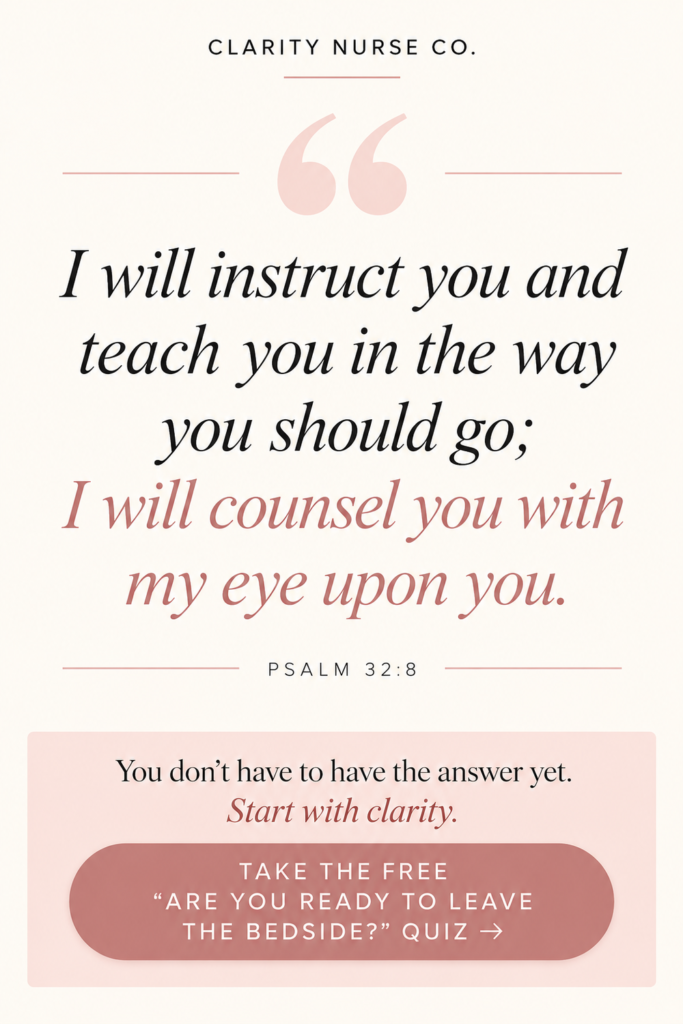
Psalm 32:8 reminds us that God will instruct us and teach us in the way we should go, watching over us with a loving eye the whole way.
You don’t have to force yourself into an immediate answer. You can research your options, ask questions, prepare for a transition, and bring the entire decision to God while you do it. Trust Him with the process and He will prepare the position for you.
Questions Worth Asking Yourself
As you look through this list of remote nursing jobs, it helps to get specific about what you’re actually looking for:
- Which roles use the parts of nursing you still enjoy, and which parts of bedside are you hoping to leave behind?
- Do you want less patient interaction, or simply a different kind of patient interaction?
- Would you rather spend your workday teaching, analyzing, coordinating, writing, problem-solving, or talking with people?
- What skills or experience would you realistically need to strengthen before pursuing the roles that interest you?
- Have you actually prayed about this, or have you only researched it?
It’s easy to spend a Saturday scrolling job boards and call it discernment, but research is important without it being the whole process. Bring God the excitement you feel about working from home, the fear that you won’t qualify, the guilt you may feel about leaving your unit, and the part of you that wonders whether wanting something different makes you less of a nurse. You don’t need to clean up those feelings before you bring them to Him.
If you’re seriously considering a transition, this is also a good time to read 6 Things to Do Before Leaving Bedside Nursing before you begin sending applications.
Not Sure Which of These Remote Nursing Jobs Is Right for You?
After thirteen options, you might be wondering less about whether other paths exist and more about which one actually fits you.
Maybe you’re happiest heads-down in a chart. Maybe you still love talking with patients, just not on your feet for twelve hours. Maybe teaching is what excites you, or you’d rather analyze than spend all day on the phone. Those differences matter when you’re choosing your next step.
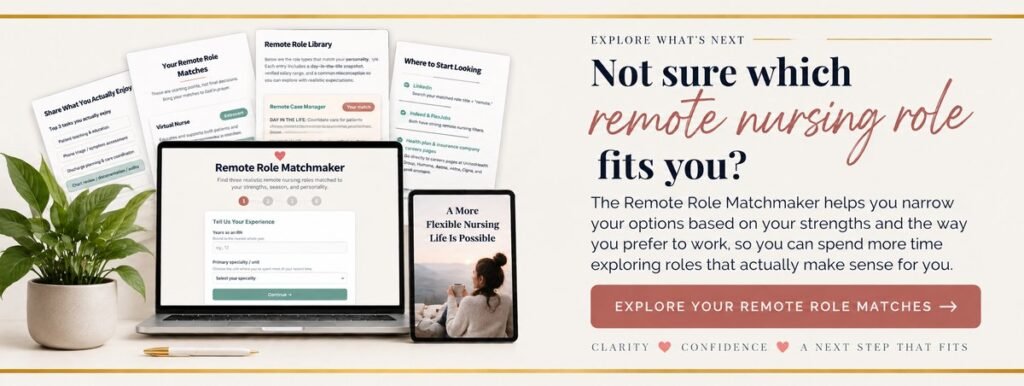
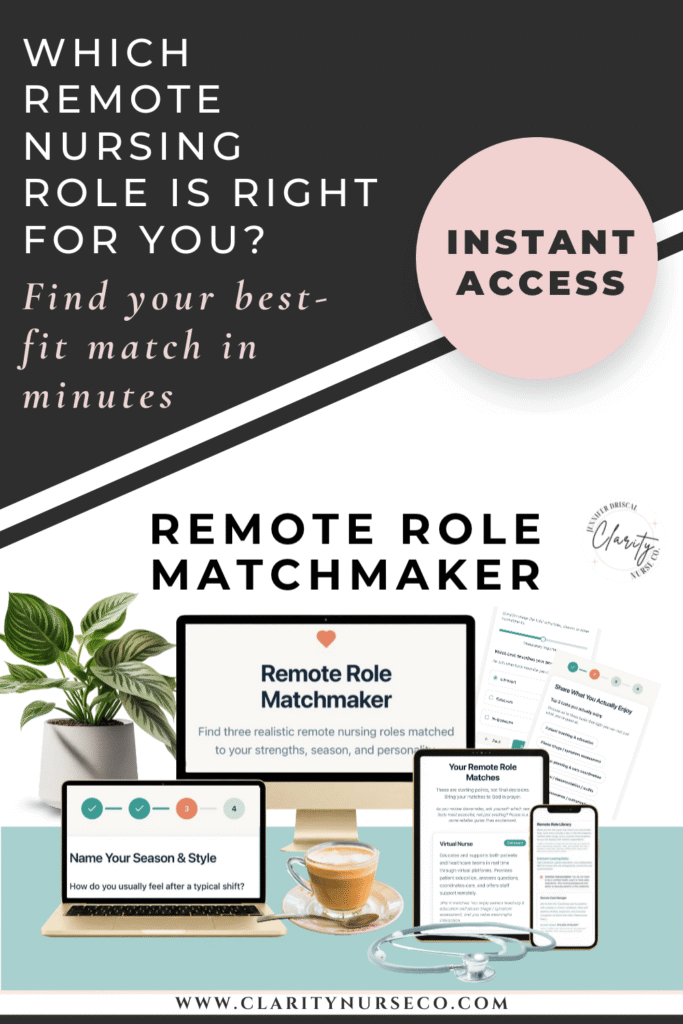
That’s why I created the Remote Role Matchmaker. It narrows the options based on your strengths and how you actually like to work, so you’re not just guessing.
Still Not Sure You’re Ready to Leave Bedside?
If you reached the end of this article and realized you’re not actually sure whether you’re ready to leave bedside yet, that’s okay too. You may be researching remote nursing because you genuinely feel ready for a change, or you may be here because your last shift was so difficult that you wanted to hand in your badge before you reached the parking lot, and those aren’t necessarily the same thing.
The free Are You Ready to Leave the Bedside? quiz can help you slow down and look honestly at where you are before deciding where you need to go.
[Take the Free Bedside Clarity Quiz →]
Final Thoughts
Exploring remote nursing jobs doesn’t mean you have to leave your current position tomorrow. It doesn’t mean you’re abandoning nursing, and it doesn’t mean every role on this list needs to become part of your plan.
For now, your next step may simply be noticing which roles made you think, which one made you curious, which one sounded like work you could actually see yourself doing, or which one made you think, “I didn’t know nurses could do that.” That’s exactly where to start.
Sometimes clarity doesn’t arrive as a complete five-year plan. Sometimes it starts with learning what’s possible, praying about what fits, and taking one faithful next step.